
01 / Items and weights
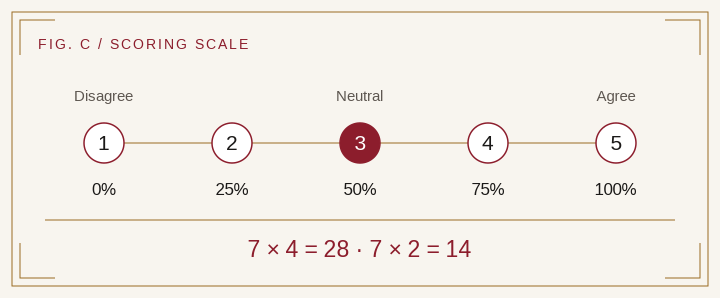
Each scenario belongs to one axis. The full edition has four items per axis; the quick edition uses the first two of those four. All items have equal weight and positive direction. The five response values are 1 (strongly disagree), 2 (disagree), 3 (neither), 4 (agree), and 5 (strongly agree). There is no reverse scoring.
02 / The 0–100% radar
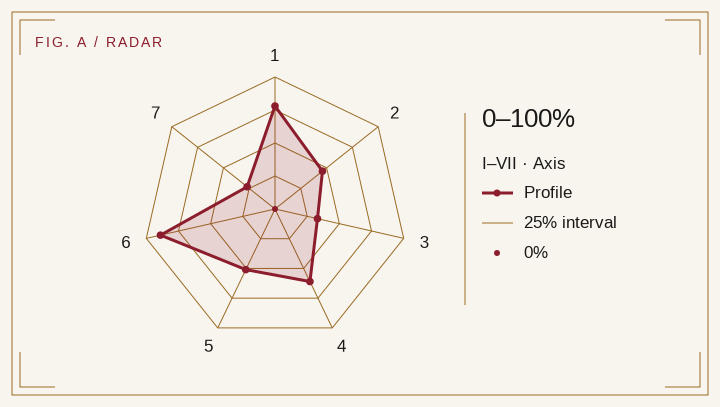
For an axis with n answered scenarios, use 100 × Σ(answer − 1) ÷ (4 × n). For example, answers 2, 3, 4 and 5 give (1 + 2 + 3 + 4) ÷ 16 × 100 = 62.5%, displayed as 63%. A neutral answer counts toward the mean. A blank answer is excluded; if n is zero, there is no plotted point and the list shows a dash. Radial distances are unrounded; labels use whole percentages. The seven axes are independent and need not add to 100%.
03 / Ranking and sharing
Final rankings appear only after all active questions are answered. Compare exact sums, not rounded labels. Ties share a tier. The next distinct score is the secondary shadow; the lowest distinct tier is the highest restraint, even when only two distinct scores exist. If all seven tie, the profile does not nominate a sin or virtue. With tied leaders, the atlas lists their counterpart virtues together.
The PNG is a 2× export of a 600 × 750 design. The result link carries the edition and seven raw sums in its URL fragment, not the response sequence. A received result is read-only and does not replace your draft. Switching languages can recover the same local run on the same origin.
04 / Limits and sources
These are original editorial prompts, not a validated scale. Scores are not percentiles, diagnoses, enduring traits or moral grades. Context, translation, social desirability and the small number of items affect what the scores can say. The virtue pairings are this atlas’s practical reading aid, not a universal theological table.
For the historical background, see Evagrius, Praktikos §§6–14, Gregory I, Moralia in Iob XXXI §87 and Dante, Purgatorio X–XXVII. Return to the test.